Friday, May 13, 2011

Exploring Sustainable Living Solutions in Asheville

Meeting people who are determined to improve the world was a great way to spend a day in Asheville, a city strongly associated with ecology and green living. Each person I spoke with at the Natural Building Extravaganza has been struck by the ridiculousness of people working 30 years to pay for a house in our country when the materials for building a home are found in on near most sites, especially in clay-rich, heavily-wooded North Carolina.
Attendees at the Natural Building Extravaganza in Asheville for the last three weeks have been learning

how to lay stone foundations and walls;
how to make and lay bricks;
how to use permaculture ideas to store and utilize rainwater; how to build an inexpensive, highly efficient cooking system from a metal drum and clay;

how to build with bamboo, with wood, or with wattle and daub;

and how to build or face buildings with cob and plaster. Cob is a natural building material made of sand, clay, water, earth, and straw. It is similar to adobe, daub, or the material that is compressed into bricks. On site, the Extravaganza attendees mixed the ingredients similar to the methods used in developing countries, in a bucket or on the ground.

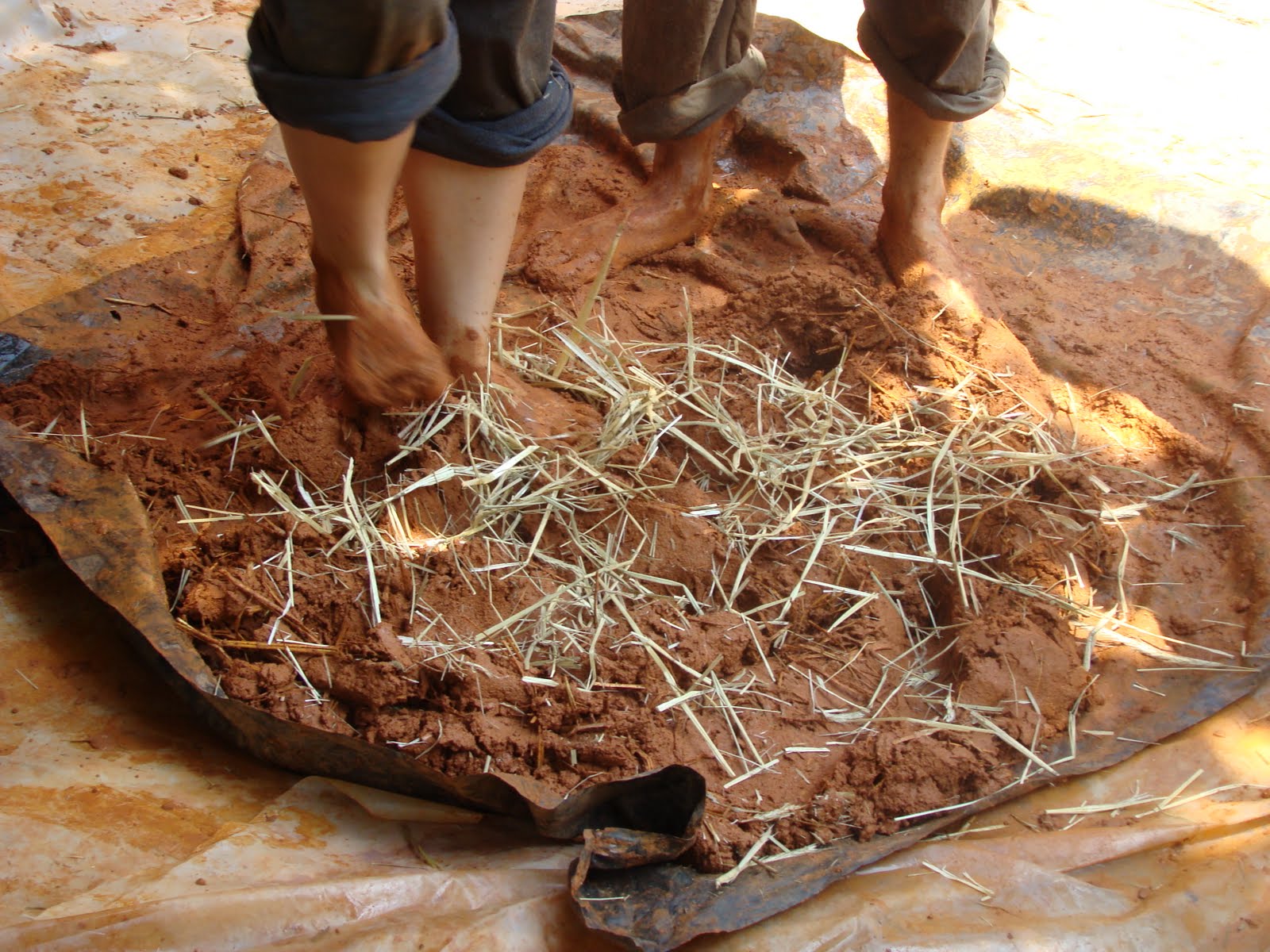

In their daily lives, these participants try to ameliorate the negative effects of humans on the environment by staying involved in some type of ecological or earth-friendly work, movement, or lifestyle, from the modern Transition Initiative started in England by Rob Hopkins to a basic back-to-earth movement that, according to NBExtravaganza participant Patrick, “can trace its roots back to the 1960s when the hippies left Haight Ashbury and moved to the farms.”


Patrick continued, “This particular group is very diverse but they are like-minded when it comes to this, and willing to offer their talents and remarkable skill base to everyone. Some of the people here have a wealth of knowledge, and can build amazing things with natural materials using minimum tools.”
(Follow link to "We don't need no stinkin' chisel.")

One of these talented jack-of-all-trades is a kilt-wearing carpenter named Fez who, when he isn't building, helps with festival productions and logistics and operations for expeditions to Antarctica, Greenland, and the Canadian high Arctic. Fez agrees with Patrick's assessment of the sense of community created by the group's common bond. As he eloquently stated, “For a lot of people here, this is a start of a journey; for others, it is a continuation. This community is formed around earthen building practices, but the greatest thing we’ve gained in coming here is connectivity—connectivity with earth and with each other.” Spending three weeks toiling, sweating, and living together does build a sense of community as well as purpose.

As I looked around at the beautiful three-tiered stone wall, the bamboo trellises, the paths and ponds, the cob-and-handmade-brick casita, the outdoor fireplace, the cob-built barrel oven and grill, the new surface on the exterior of the house and the new walkway through the greenhouse, and then looked at the tents on the hillside where the Extravaganza attendees had been living for up to three weeks, I was impressed with the dedication and determination of the participants and also with how much had been accomplished in such a short time.
It takes a lot of effort and organizational skills to coordinate a building workshop, especially one that lasts for three weeks.

Janell Kapoor, the founder of Kleiworks International, which organized the Extravaganza with the Ashevillage Institute, served as the leader of the conference and coordinator of the daily work routine. She was also busy inspecting and instructing novice plasterers.


The intricate three-dimensional designs in the cob exterior of the house were beautiful:


Janell had help with the organizational aspects of the Extravaganza from her roommate Lisa. Shopping for food and handling money were among her duties. Lisa located a lamb for the Friday night dinner party, to be cooked in the newly-built, highly-efficient cob oven. She also led us in singing a Sufi song of blessing and praise during the morning circle. If you want to hear the morning circle song, click here. (Some things you just have to be there for.)

Janell’s personal assistant is Rose, a cheerful woman from India whose other name is Unnathi Boblak. Rose grew up in New York with a Polish mother. During the time I was there, Rose stayed busy in the background, doing everything from cleaning dishes to making the wheat paste that is used to thicken and stiffen the cob mixture. The gluten in the wheat paste acts as a kind of glue to help hold the cob mixture together and in place when it is applied vertically. It stiffens the cob mixture. The wheat paste is made from two parts cold water mixed with 1 part flour (any kind of wheat flour) and then boiled in 4 parts water and stirred until it thickens. Rose participated in the building projects, too. She learned how to cut, connect, and shape bamboo while helping to build the beautiful arched trellises leading into the gardens. Joinery is an important part of building.

Sometimes things are laid together in grooves like the heavy wooden crossbeam behind the bamboo gate,

sometimes things are braced and tied, and sometimes they have a mortise and tenon construction. All three are used at the Extravaganza site, depending on what materials are available.

Fallen trees may have their bark removed and used in rounded form, or may be planed and used as posts, as they were in the cornerposts of this tool shed.

The great thing about building naturally with what's on site is that everything does not have to be vertical or square; walls and roofs can take a curvier shape.


Participants use fewer tools than traditional builders but an electric drill still comes in handy.

A few conference participants arrived three weeks before the conference began. Julie, who has traveled extensively and biked across our country from Portland, Oregon, to the Atlantic and then down to Florida, loves the idea of natural building techniques because “they are accessible to anybody.”
Julie arrived in Asheville about two months ago and has been on site for six of those eight weeks. During the three weeks before the conference, she helped get things ready for the workshops by hauling materials (gravel, sand, clay) in buckets and by wheelbarrow, by clearing land and preparing sites, by making platforms for tents, and by creating paths through woods and along the hillside. In exchange, she had food and a place to stay, but most importantly she had the opportunity to learn from teachers who arrived early, too, and then attended the conference in exchange for her work.
The registration fee for the full three weeks of the conference was $1800. Some people volunteer skills such as cooking in exchange for the chance to learn at a discounted price. The day I was there, Rachel
made a delicious vegetarian lunch consisting of a salad, a quinoa dish, and a warm bean dish that included carrots and potatoes.
The Extravaganzans feel strongly that each person should do whatever is within his or her power to improve the sustainability of the earth, and that it is urgent to do so. By working together or through individual efforts, people can collectively improve the likelihood of a sustainable earth, despite oil spills, agricultural and industrial and pharmacological pollution, genetic modifications gone awry, and other problems.
For earth to have a chance to recover, it is imperative that people learn to live more harmoniously with nature. One way to do this is by building “naturally” with earth or clay.
Kelly, a past volunteer with Habitat for Humanity, was struck by the amount of waste in modern construction methods. “Our building methods are not good for the environment—construction and building materials account for a large portion of our landfill waste. A lot of toxins are involved in the production of our construction materials, too, so anything we can do to use natural materials with less waste is bound to be good for the environment.” A few years ago, she began reading about building with cob and has come to the Extravaganza for hands-on learning. I doubt if she was disappointed; when I saw her, she was up to her elbows at the casita,
installing old bottles within the cob structure. “I felt like I had learned everything I needed from the book, but what’s nice about coming here is that the materials have already been gathered—the clay, the straw, and the other things you need—and you can get experience building a house.”
In addition to the problems of waste and toxins, construction in the urban, industrialized world expends a lot of fuel producing and transporting construction materials. Although creating city infrastructure and large buildings requires some of this, much waste can be avoided with individual residential structures if people are allowed to build with what’s at hand. These ancient building techniques stand the test of time, and most of the participants, not surprisingly, intend to build their own home eventually using at least some of the natural building techniques they have learned at the Extravaganza.

Cassie, an Executive Assistant to the President of a local bank, took a week off work and used her vacation time to learn more about the process. She sees it as a natural next step since she started organic gardening last year. She has always wanted to design and build her own home.
Building codes must be updated to accommodate people wanting to build their own houses using regional materials as much as possible, and the alternative building methods they sometimes require. Bureaucratic regulations and code-enforcers are typically not oriented toward those who desire ecologically-friendly, safe, alternative homes. The rules that are designed for large-scale city living often create an unreasonable obstacle for smaller-scale earth-friendly housing.

Regulations can stand in the way not only in building codes but in other areas of self-sufficient, sustainable living. For example, while complaining about run-off, municipal governments often have regulations which hinder the use of rainwater and recycled water on site, thereby contributing to the problem.
The permaculture movement in Asheville, heavily “infested” with PhDs, is working to spread the knowledge of how permaculture design can help all of us, including city water and sewer systems.
The Extravaganza’s permaculture expert, Enzo, works with the Sustainable Systems Research Center in Asheville, which in turn is associated with the Asheville Center for Ecological Economics. Formerly Enzo and his wife Jessica developed the site plan for the Mother Earth News Ecovillage Permaculture Education Center. With permaculture, the idea is that water is captured as high as possible (from a roof or on a hill) and used, preferably more than once, as gravity works its magic and pulls the water through natural filtering systems.


At the Extravaganza site in hilly Asheville, swales, which are water-catching basins dug along the contours of a hill, drain into a collection pond, which feeds into pipes and more swales. The water is used for gardens down the hill
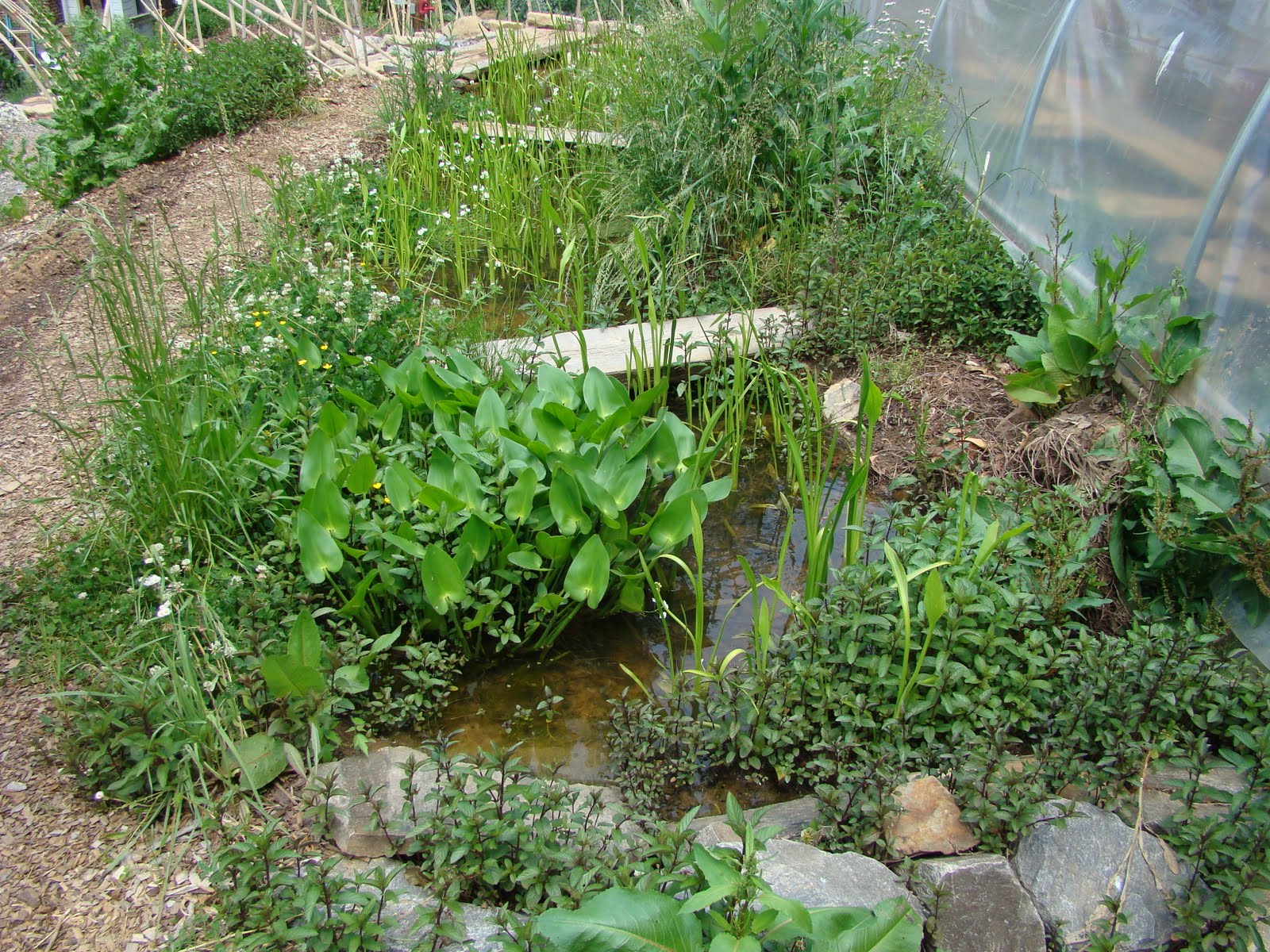


and to feed into a greenhouse which contains a creek where fish are grown and where a platform lets chickens warm themselves in winter.

This water then empties into a decorative “fire” pond which could be used to supplement fire-fighting efforts if needed.

The location of the fire pond would permit gravity to have enough force to spray the backside of the residence while the city fights flames from the front.
Tilapia and Italian bass and Gambezi fish, which eat larvae of mosquitoes, are all good choices for aquaculture. And by the way, the fish eat chicken poop, changing it from waste to nutrients.
Enzo pointed out the primary filter on the home’s rainwater collection system, which removes items such as leaves and twigs that might make their way into the gutter. It is in the white square object mounted on the wall at the break in the black drainpipe.

Another filter, a Berkey-style filter, could be added to produce drinkable water. A simple Berkey-style filter, such as a five-gallon bucket containing half sand and half charcoal, would filter out pollen and airborne particulates.
Besides incorporating passive solar and permaculture principles in new designs and retrofits, natural builders encourage the use of efficient methods of heating and cooking. One item that could add a lot to almost any backyard is the barrel oven, a wood-efficient oven which can be built at very low cost using mostly natural and recycled materials.

The oven cooks in a highly efficient manner thanks to its design, which utilizes a 2" space all around the drum for the heat to pass around as the fire below it heats up. The drum is on its side, with the lid becoming the door.
The lid's modifications include a rest for the lid when the door is open. The ash drawer below the drum can be partially opened to adjust the rate of air flow and the heat. A company called Firespeaking manufactures kits with all the metal parts you need to build one of these ovens yourself. Eva Edleson, one of the owners of Firespeaking, made it look like a piece of cake to build one.

She loves to make things and loves to inspire others to create their own things from local materials--pottery, ovens, food, whatever they can. "A lot gets shared through the passage of time over food at a dinner table."


The Natural Building Extravaganza is held on the site of two adjoining conventionally-constructed homes in a settled, traditional neighborhood in Asheville. The homes were re-surfaced with earthen cob and plaster, and the backyards were landscaped using permaculture design, with the goal of providing food for the homeowner. The idea is to demonstrate that building methods which combine ecologically-friendly living with self-sufficiency and a sustainable lifestyle can be employed within a “normal” urban setting.
Although the Natural Building Extravaganza is an annual event, and the site is not open year-round, the Asheville area has many workshops available throughout the year, as well as ecologically-minded sites open all year. For workshops, try Ashevillage Institute, an educational group that does permaculture and natural building classes that is featuring a 10-month ecological leadership program in 2012. For permanent exhibitions, check out Earth Ship or Earth Haven Ecovillage, which combines “natural” and standard construction methods and offers ideas about lay-out and efficient use of space.

Monday, May 9, 2011

Mothers, Goats, and Talking Trees

For Mother’s Day, my husband and I visited Celebrity Goat Dairy bed and breakfast near Siler City. Many famous names were there. It was exciting to get to know some of the celebrities rather intimately in such a short time. They were entertaining, and some of them must have found me interesting, too, since they were eating out of my hand.
Why the name Celebrity Goat Dairy? The farm-owner's daughter, now grown, has an interest in theater; she named the goats for celebrities. The goats are fed and handled by humans from birth, which makes them comfortable around people, not skittish; in fact, the goats seem to enjoy attention. The idea of these goats being celebrities seems to fit. Rather than ear-tags, these goats sport necklaces (also known as collars). The logo for the dairy farm features a goat wearing sunglasses and a necklace.

Among the celebrities are Betty Grable, so named for her great legs, and Dolly Parton, named for the obvious, who produces quite a bit of milk. On average, a good milking goat produces between 3 and 4 quarts a day. Most of it at this cheese-making facility—about 80 to 85%--becomes whey, which is the liquid that drains off through the filters as the milk solids are collected. The whey is then mixed with water and fed back to the goats while the milk solids are made into goat cheese, called chevre. (It has an accent mark, but I don't know how to insert one on the computer.) Next to the milking room is a filtering room, and next to that is the pasteurization and cheese-making operation.
Established in 1987, Celebrity Goat Dairy has grown into a sort of “dude ranch” where guests at the bed and breakfast are welcome to try their hands at simple farm work. The goats are fed and milked at 6 a.m. and 6 p.m., but since there are 80 milking goats and only 16 spaces for them to be milked, and only two automatic milkers for the 16 spaces, milking takes about two hours. I was able to feed and milk the goats with guidance from a farmhand. The goats do the herding themselves. They march up the ramp to the milking platform and eagerly thrust their heads into the stanchion (a metal headlock) to reach the feed bins. It was amazing to watch them trot in and up the ramp and then line up by themselves at the feed bin--one goat at a time putting its head into the stanchion, going in order down the row. The next goat in line couldn't put her head into the stanchion until the one to its right had done so. The very last goat into the milking room sneaked around to where I was pouring feed into the bins and stood on her hind legs to lap the food out instead of going up the ramp. Apparently she was too impatient or hungry to wait for the others to get themselves into place, which would thereby free up her spot and allow her access to the stanchion and the feed on the other side. The goats’ udders are full so they want to be milked; as soon as the rest of the goats were in place, the food-sneaking goat (Kirstie Alley?) scooted back around, trotted up the ramp, and accessed the feed trough in the proper way.
Currently the 330-acre farm has two "useless" llamas, dozens of chickens, a couple of roosters, some guinea fowl, and three cows. Also, in addition to the 80 milking goats, there are two billygoats and roughly 30 kids. All the nannies deliver babies every year, and can have three at a time. The young goats are sold for $25.00 at birth, plus $5.00 per week that they’ve been kept and bottle-fed.
The cows are a new addition. Goats and cows are considered good grazing partners because they supposedly don’t share parasites with goats, and because they eat different foliage: cattle prefer grass whereas goats prefer flowers and more woody things, according to Brit, the farmer. Since the cattle were dropped off by a neighbor before the fences were inspected and reinforced, they’ve been roaming at will—-mainly to get away from the llamas who don’t seem to want them there. So far they haven't been sharing the goat pastures, so the jury is still out regarding a decision about whether it is a good idea for cows and goats to share the pasture.
A word to Bill: The Celebrity Dairy didn’t have a senior citizens’ contest, so I couldn’t register my husband in the competition for title of “Celebrity Old Goat.” Thanks for the suggestion, though.
We ventured down the road to Saxapahaw, where the Haw River Festival was in progress. We enjoyed the art for sale, both in the booths and in the artists’ gallery beside the festival. Some of the most interesting creations were made of reconstituted ceramics (heated and reformed), decorated with pieces of metal fused into them, made into bowls and other useful objects. The old textile mill at Saxapahaw has been converted into condominiums, stores, a charter school, and a couple of restaurants…all on one site. I bet the former employees of the mill never imagined that people would be drinking five-dollar beers in their sweaty, lint-filled workrooms. For that matter, the owner probably didn’t, either. But his grandson imagined it once the mill closed.
In nearby Siler City, five buildings were used to create an Arts Incubator, with a gallery/store, a coffee shop, and 24 artists’ studios. Handmade greeting cards, pottery, and jewelry were abundant, but my favorite things at this location were the drinking glasses made from wine bottles which had been cut and polished, then etched (sandblasted?) with designs.


In the evening, back at Celebrity Goat Dairy, after milking was completed and the baby goats were petted, we sat on the porch swing by the geraniums. Nearby a duck sat on her nest on the ground tucked against the house under an eave.
We listened to cicadas and talked with our traveling companions about the cloudy sky blocking our view of the stars. In the morning we awoke to a rooster scratching outside our window—perhaps harassing the duck on her nest but maybe just scratching for insects.
Breakfast included bacon, eggs, grits, fruit, and johnnycake made with freshly ground cornmeal and flour from Lindley’s Mill, a mill that was supposedly established in 1755 and saw a skirmish during the Revolutionary War. It now produces organic flour and meal, and although everyone seems to call it Lindley's Mill, the official name now is Lindley Mills, I believe. An alternate date of establishment is given as 1781, but either way, the mill was the scene of a historic battle which you can read about at this link to Our State magazine archives.


After a filling “farm” breakfast at a communal table in the inn’s main reception room (which featured a fireplace made by a sculptor/stone mason), we said good-bye to the goats and chickens, and drove to Jordan Lake, where we took a walk over the Talking Tree Trail, featuring well-marked trees and push-button recordings that featured a voice with a southern accent…appropriate enough since the trees were definitely southern.

One of the most interesting types of trees I learned about was the Shagbark Hickory:
Some of them were quite shaggy.
Afterward, we drove over to the NC Botanical Gardens in Chapel Hill and took another walk through woods by following the Streamside Trail. At this location, on or near the University campus, trees soared over 100 feet in the air, including pine trees with such thick trunks that just one person couldn’t wrap his arms around them. Deciduous trees that were over one hundred years old were impressively tall; just looking up at them and thinking about all the storms and the history they’ve weathered helped us gain a different perspective.
It was Mother’s Day, which meant Graduation Day in Chapel Hill, so after our walk we headed out of town to avoid vying with the happy, celebratory crowds for dinner spots at local restaurants. We returned home in time to see a movie with our movie-watching friends, and then talked with children who were calling and emailing wishes for Mother’s Day. Hope yours was happy!

Monday, April 18, 2011

Tornadoes and Warthogs in Eastern NC

Saturday evening, my husband "Buck" and I were at a bed and breakfast in-between the communities of Jason and Shine, which is near Snow Hill (eastern North Carolina), where some vicious weather roared through. When we first arrived at the Benjamin Best Bed and Breakfast, we went on a tour of the farm's cattle-raising operation. This particular farm has developed its own special brand for the "natural" Black Angus beef they sell: Nooherooka (if I spelled it right). Their slogan is "Our cows don't do drugs" because they raise them without antibiotics and hormones.

If one of the cows gets sick and requires antibiotics, they tag it, isolate it, and sell it separately.
The man and woman who own the farm, Ossie and Mary Betty Kearney, had a wide variety of interests. Ossie showed us the home they had restored and told us about refinishing the old floors with lye-water because the historic preservation commission advised against sanding the floors. He told us a lot about raising cows and pigs, including separating the cows by age into different fields. The Kearneys make sure the cows always have access to grazing-pasture, to water, and to shelter such as trees. To someone who lives in the city, the farm equipment can be riveting (pardon the pun). One of the tractors had a long spear on the front to stab a bale of hay and transport it. And I thought the corral with the electric motor which helps load itself for transport would have been handy when I was traveling while raising my kids...just kidding (not really, but it probably would've been less traumatic than the cattle prod). Because the Kearneys don't use hormones, their cows take a little longer to grow to selling-size, but Ossie and his son still get them to market before they are 30 months old. If you are squeamish, skip to the next paragraph NOW, but I found this fact of farm life fascinating. I asked Ossie what process they use to castrate the male calves since they only need one bull for every 30 cows, and they want the rest of them to become steers for beef. He explained that they use something like a rubberband to tie around the testicles to block the blood flow, and they will just fall off after awhile...no surgery is needed. He said that after a couple of hours, they seem to get used to it; it probably goes numb.
Ossie's wife, Mary Betty, was really interested in historic preservation and had helped to create a book called Architecture of Greene County. She is a great advocate for the "slow food" farm-to-market movement, and was very interesting to talk with. She is an elegant Southern lady with hair swept into an up-do in the back, and very gracious, but not stuffy at all, one who enjoys yard-work and gardening. I can't think of two nicer people to be huddled with in a small room while waiting for the severe weather to pass.
Tornadoes passed through just north of us and just south of us. We were in a 150-year old house and were very lucky they didn't hit where we were. According to the reports, a house was flattened less than a quarter-mile from where we were. And in another direction, the new middle school for the county was destroyed. A barn downtown which had just been moved to a museum site (intended to be used as a downtown Farmer's Market) was nowhere to be found. Phone calls reported that several people were injured in a restaurant in a strip mall when the plate glass blew out of the front window. Trees were down and lots of trailers were either turned over or had roofs ripped off, and there was damage to the greenhouses. Twenty people died in Bertie County, a little further east. Seeing how precarious farming is, with electricity cutting the heat and lights in the turkeyhouses and hearing about some of the damage that weather in general does to crops makes me appreciate even more those whose work provides my food. The tornadoes moved through quickly, but were then followed by more, one after another. Of course the electricity was off until the wee hours of the morning. Ossie stayed up making sure the meat freezers stayed cold, which I suppose he did with generators, working out in the wind and the dark.
Despite the tornadoes, "Buck" and I had a good dinner at a restaurant called Sandpipers (which still had electricity), a good night's sleep in a beautifully appointed room, and a wonderful breakfast in front of a fire on Sunday morning, with excellent company from the hosts and the other guests. Thanks to the electricity being out, we were able to experience the 150-year-old house closer to the way the original inhabitants did--with candles for light, and without any heat. That part was kind of fun. It was great to see how the neighbors chipped in to help each other put tarps over the damaged roofs, gather cows back into fields which had their enclosures knocked down by fallen trees, and so forth. Men with tractors pushed trees out of the roads without waiting for the state highway vehicles to come and do it for them. It was refreshing to witness the self-reliance in this county of only 20,000 people (2,000 of which, I was told, are incarcerated in the three federal and state prisons).
After our Sunday morning breakfast, which was so ample that it lasted us until suppertime, we went to an air show (Wings Over Wayne) at Seymour Johnson Air Force Base at Goldsboro. It was thrilling to see the fighter planes and jets zooming by and demonstrating their maneuvers. It actually made me feel a lot better about paying all that money in federal income tax last Friday. My favorite part of the show was not the Thunderbirds, but the Heritage part that showcased the air force "work horses" past and present: the P-51 Mustang (developed with Britain during World War II and featuring a Rolls-Royce engine), the A-10 Thunderbolt (also known as the Warthog for its ruggedness and "good looks"), the F-4 (called a Phantom or Super Hornet), and the staple at Seymour Johnson--the F-15E "Strike Eagle." According to one of its fans, a Strike Eagle can go from 50 feet above the ground up to 20,000 feet in 15 seconds. All I know it that it sure did it fast! Flying that jet looked like fun jet as the pilot demonstrated its maneuverability. He made a circle with that jet over about a 1400 foot long area. It was very impressive. As the announcer said, "You can't fight if you can't turn tight." The announcer said it enabled the same pilot to turn and strafe the enemy about every 10-15 seconds. To minimize collateral damage, the F-15E is equipped with only a 20 mm Gatlin gun on the front. This is smaller than the 70 mm Gatlin gun on the front of the older Warthog jet, which sprays bullets the size of a Coke bottle. The Warthogs have faces painted on their fronts, which give them some individual personality, and it looks as though a lot of the F-15 pilots are following the tradition.
After the air show, we stopped at Wilbur's BBQ just outside Goldsboro...I think "Buck" said we were at a community called Elroy. Wilbur's is famous in eastern North Carolina because of its eastern-style barbecue, which is different from Lexington-style (the type served near my home). Wilbur's barbecue was delicious and is worth a stop if you are in the vicinity of Goldsboro, but honestly, I like Smithfield's BBQ (which is now a chain) just as well as Wilbur's, if not more, and you don't have to drive to Goldsboro to get it. Still, if you are in the vicinity of Goldsboro, you should try Wilbur's for comparison.
Between the tornadoes and the warthogs, it was more exciting than I had anticipated, especially considering how rural the countryside was. It wasn't exactly tranquil. As we headed east from Raleigh on our way there Saturday morning, it felt like we were riding into the middle of nowhere, but sometimes that's where you have to go to see huge swaths of countryside with cows and pigs. Who could have guessed we'd have so much excitement and fun? Thanks to the Kearneys and the military servicemen and women for a fun weekend! I hope those who suffered the full force of the tornadoes are getting the help they need.
Looking ahead, we are going to the Cook Shack in Union Grove on Wednesday night to see the French band "MaryLou", whose music focuses on American traditional, which I find amazing and amusing because they are not only French but still live in France. When they play there, I wonder if the audience can understand them. It is kind of odd to hear them sing our folk songs with a French accent; for example, "Michael Row Your Boat Ashore" sung very earnestly with a slight French accent. If you want to have some fun, try it yourself! At the Cook Shack, musicians from Asia, Germany, Switzerland, and France regularly attend the Saturday morning jam sessions and evening concerts, so I guess it shouldn't be too surprising that American traditional music has an international appeal among certain people.